


Page 41 - choverestishrei5782
P. 41
38 |   Harav Yonah Lazar                                         Harav Yonah Lazar   |   39


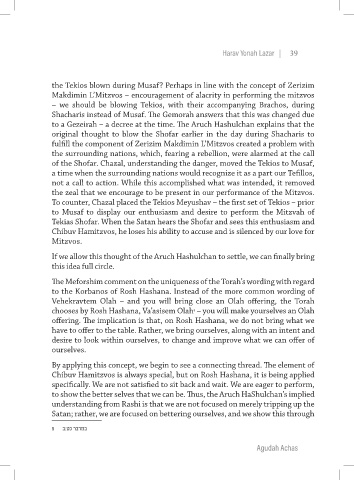
 Hashem, we perform this ritual year after year and will, B’Ezras Hashem,   the Tekios blown during Musaf? Perhaps in line with the concept of Zerizim
 continue to do so in good health, B’Arichus Yomim V’Shanim, for many years   Makdimin L’Mitzvos – encouragement of alacrity in performing the mitzvos
 to come. How is it possible that the Satan still can be “confused” by an act that   – we should be blowing Tekios, with their accompanying Brachos, during
 we repeat year after year?  Shacharis instead of Musaf. The Gemorah answers that this was changed due
                to a Gezeirah – a decree at the time. The Aruch Hashulchan explains that the
 The Gemorah in Rosh Hashana  also refers to this concept of confusing the   original thought to blow the Shofar earlier in the day during Shacharis to
 4
 Satan. Rabi Yitzchak asks: Why do we blow the shofar? The Gemorah answers,   fulfill the component of Zerizim Makdimin L’Mitzvos created a problem with
 what question is that – Rachmana Amar Tiku – the Torah says to blow the   the surrounding nations, which, fearing a rebellion, were alarmed at the call
 Shofar. The Gemorah continues to analyze the question, until it finally   of the Shofar. Chazal, understanding the danger, moved the Tekios to Musaf,
 determines the true inquiry of Rabi Yitzchak: Why do we blow the Shofar   a time when the surrounding nations would recognize it as a part our Tefillos,
 twice, once, Meyushav – before we daven Shemonei Esrei, and a second time,   not a call to action. While this accomplished what was intended, it removed
 Meumad – during a portion of Shemonei Esrei. Answers the Gemorah: Kdei   the zeal that we encourage to be present in our performance of the Mitzvos.
 Learveiv Hasatan – in order to confuse the Satan.
                To counter, Chazal placed the Tekios Meyushav – the first set of Tekios – prior
 One can see why we might try to confuse the Satan prior to Rosh Hashana. If   to Musaf to display our enthusiasm and desire to perform the Mitzvah of
 the Satan misses Rosh Hashana, we will escape his accusations. But on Rosh   Tekias Shofar. When the Satan hears the Shofar and sees this enthusiasm and
 Hashana itself, we are standing before Hakadosh Boruch Hu – Melech Malchei   Chibuv Hamitzvos, he loses his ability to accuse and is silenced by our love for
 Hamelachim – with the opportunity to plead our case. Why waste even a   Mitzvos.
 second of our precious time before Hashem trying to trick the Satan?
                If we allow this thought of the Aruch Hashulchan to settle, we can finally bring
 Tosfos  explains that the purpose of blowing the Shofar twice is truly to confuse   this idea full circle.
 5
 the Satan. When the Satan hears the Shofar and then hears the second set of   The Meforshim comment on the uniqueness of the Torah’s wording with regard
 Shofar blasts, he believes that these Tekios are the final blasts of the final   to the Korbanos of Rosh Hashana. Instead of the more common wording of
 redemption, signaling the coming of the Geulah and the end of the Satan’s   Vehekravtem Olah – and you will bring close an Olah offering, the Torah
 role and ability to accuse. Rashi , in his commentary on the Gemorah, offers   chooses by Rosh Hashana, Va’asisem Olah  – you will make yourselves an Olah
 6
                                                         8
 a different approach. When the Satan sees the Chibuv Hamitzvos – love and   offering. The implication is that, on Rosh Hashana, we do not bring what we
 endearment for the Mitzvos – demonstrated by the Shofar being blown twice,   have to offer to the table. Rather, we bring ourselves, along with an intent and
 he loses his resolve to accuse and prosecute. While both Rashi and Tosfos offer   desire to look within ourselves, to change and improve what we can offer of
 valid suggestions for the message, it remains unclear why we would focus   ourselves.
 so much on the Satan at a time when we would be better served to focus on
 ourselves.     By applying this concept, we begin to see a connecting thread. The element of
                Chibuv Hamitzvos is always special, but on Rosh Hashana, it is being applied
 The Aruch Hashulchan  was similarly bothered, specifically with regard to   specifically. We are not satisfied to sit back and wait. We are eager to perform,
 7
 Rashi’s commentary, and raises another question in the matter: Why are
                to show the better selves that we can be. Thus, the Aruch HaShulchan’s implied
 4   :זט – .זט הנשה שאר  understanding from Rashi is that we are not focused on merely tripping up the
 5   בברעל ידכ ה"ד :זט הנשה שאר ןטשה תא  Satan; rather, we are focused on bettering ourselves, and we show this through
 6   בברעל ידכ ה"ד :זט הנשה שאר
 7   ה - ג : הפקת  8   ב:טכ רבדמב

 A                                                                         Agudah Achas
 Agudah Achasgudah Achas

