


Page 57 - choverestishrei5782
P. 57
54 |   Harav Netanel Wiederblank                          Harav Netanel Wiederblank   |   55


 one unit; thus, they must be bound together as one. But if the Chakhamim are   fulfilled Jew from the other three types, as if he is to be kept aloof from them.
 to maintain that each species is meant to stand alone, then why would it be   Here too, however, we can turn to the halakha to help us with the symbolism.
 considered more beautiful to bind them together? What’s more, it is not at all   The  Shulchan  Arukh rules that when shaking the  lulav, one must unite the
 obvious why a flimsy string makes the mitzvah more beautiful. Last, why can’t   esrog with the lulav and hold them together.  The Biur haGra, which notes the
                                                           3
 we each decide individually how to beautify our performance of the mitzvah,   source for each halakha in the Shulchan Arukh, identifies as the source for this
 as we do when, for example, we decorate the sukkah?  requirement the very same Midrash that we quoted relating the four species to
                the above four types of Jews.  In other words, according to the Gra the reason
                                            4
 Perhaps we can address these questions best by bringing into consideration   why we must make sure to hold the lulav and esrog together when performing
 the deeper symbolism of the arba minim. The Midrash  records that each of the   the mitzvah is to stress that the Torah scholar is not meant to be aloof or
 2
 four species represents a different type of Jew:
                separate from the other three kinds of Jews; on the contrary, he should be
 The esrog tree, which bears a fruit with both fine taste and fragrant aroma,   together with everyone else, all of them bound together as one congregation. 5
 represents one who excels both in Torah and in good deeds.
                As this motif of social unity, reflected here in the binding of the four species,
 The lulav, which comes from a tree whose fruit, the date, has delicious taste but   appears frequently in Chazal, let us consider one more remarkable source of
 no aroma, represents one who has mastered Torah but still lacks good deeds.  Torah symbolism that may help us understand the unity we are meant to seek
                and why it’s so important.
 The hadassim, which smell good but lack fruit altogether, represent the opposite,
 one with good deeds but lacking Torah.  One of the offerings brought daily in the Temple was the sweet-smelling
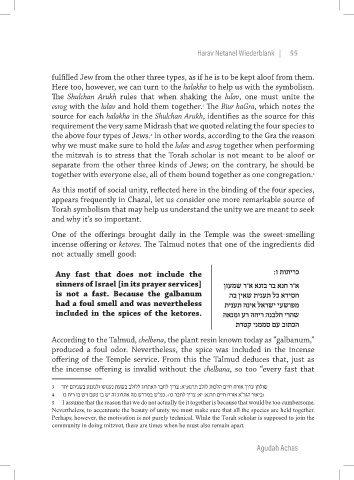
                incense offering or ketores. The Talmud notes that one of the ingredients did
 Finally, the aravos, which lack both taste and smell, represent the Jew who   not actually smell good:
 lacks both Torah and good deeds.

 The Midrash implies that the “beauty” in binding the species together reflects   Any fast that does not include the   :ו תותירכ
 the natural beauty of the people managing to unite in spite of – or, even   sinners of Israel [in its prayer services]    ןועמש ר”א אנזב רב אנח ר”א
 better, in celebration of – their inherent diversity. All sorts of people, each   is not a fast. Because the galbanum    הב ןיאש תינעת לכ אדיסח
 with their own strengths are meant to merge and unite. And this is the beauty   had a foul smell and was nevertheless    תינעת הניא לארשי יעשופמ
 of the bound lulav. Put differently, the hiddur mitzva of egged (the binding of the   included in the spices of the ketores.   האנמו ער החיר הנבלח ירהש
 species) is not aesthetic (like a esrog with an attractive shape), but symbolic.   תרטק ינממס םע בותכה
 However, an obvious question arises: Why is the esrog not bound together with   According to the Talmud, chelbena, the plant resin known today as “galbanum,”
 the other three species? According to what we’ve just advanced, its exclusion   produced a foul odor. Nevertheless, the spice was included in the incense
 from the others would seem to imply some elitist separation of the doubly   offering of the Temple service. From this the Talmud deduces that, just as
                the incense offering is invalid without the chelbana, so too “every fast that
 2   ינב םהב שי לארשי ךכ חיר וב שיו םעט וב שי הז גורתא המ לארשי ולא רדה ץע ירפ א"ד :ל השרפ רומא תשרפ )אנליו( הבר ארקיו
 שיש םהב שי לארשי םה ךכ חיר וב ןיאו םעט וב שי וזה הרמתה המ לארשי ולא םירמת תופכ םיבוט םישעמ םהב שיו הרות םהב שיש םדא   3  דחי םהינשב ענענלו ועונענ תעשב בלולל גורתאה רבחל ךירצ :אי:אנרת בלול תוכלה םייח חרוא ךורע ןחלוש
 םיבוט םישעמ םהב שיש םהב שי לארשי ךכ םעט וב ןיאו חיר וב שי סדה המ לארשי ולא תובע ץע ףנעו םיבוט םישעמ םהב ןיאו הרות םהב   4   וכ חיר וב שיו םעט וב שי הז גורתא המ שרדמב ש"מכ .›וכ רבחל ךירצ :אי :אנרת םייח חרוא א"רגה רואיב›
 םישעמ אלו הרות אל םהב ןיאש םדא ינב םהב שי לארשי םה ךכ חיר הב ןיאו םעט הב ןיא וז הברע המ לארשי ולא לחנ יברעו הרות םהב ןיאו   5   I assume that the reason that we do not actually tie it together is because that would be too cumbersome.
 התוא ךכ םתישע םאו ולא לע ולא ןירפכמ ןהו תחא הדוגא םלוכ ורשקוי ה"בקה רמא אלא רשפא יא ןדבאל םהל השוע ה"בקה המו םיבוט   Nevertheless, to accentuate the beauty of unity we must make sure that all the species are held together.
 לע ותדוגאו )›ט סומע( רמאנש תחא הדוגא ןייושע ןהשכ הלעתמ אוה יתמיאו ויתולעמ םימשב הנובה )ט סומע( ד"הה הלעתמ ינא העש   Perhaps, however, the motivation is not purely technical. While the Torah scholar is supposed to join the
 ןושארה םויב םכל םתחקלו לארשיל ריהזמ השמ ךכיפל הדסי ץרא.  community in doing mitzvot, there are times when he must also remain apart.

 Agudah Achasgudah Achas
 A                                                                         Agudah Achas

